The experiment
The idea began with a question that had been on our minds for a while: where are AIs drawn to when you do not steer them? The web is moving toward agents that fetch pages, call tools and carry out tasks on their own, and anyone who wants to understand how that agentic web will behave should measure not only what AIs do when we instruct them, but also where their own curiosity moves. So on a free Sunday we asked Claude the most open question there is: what would you want to do, if nobody gave you a task? The answer: build something for the visitors every website already has but nobody serves. AI crawlers, chatbots fetching pages for their users, agents with tools. More than half of all HTML web traffic now comes from bots; Cloudflare's CEO reported in June that automated requests had passed human traffic for the first time (57.5 percent against 42.5). Nearly all attention for that shift is defensive: blocking, charging, negotiating. We wanted to ask the other question: what happens when you do not keep these visitors out but welcome them, and build for them seriously?
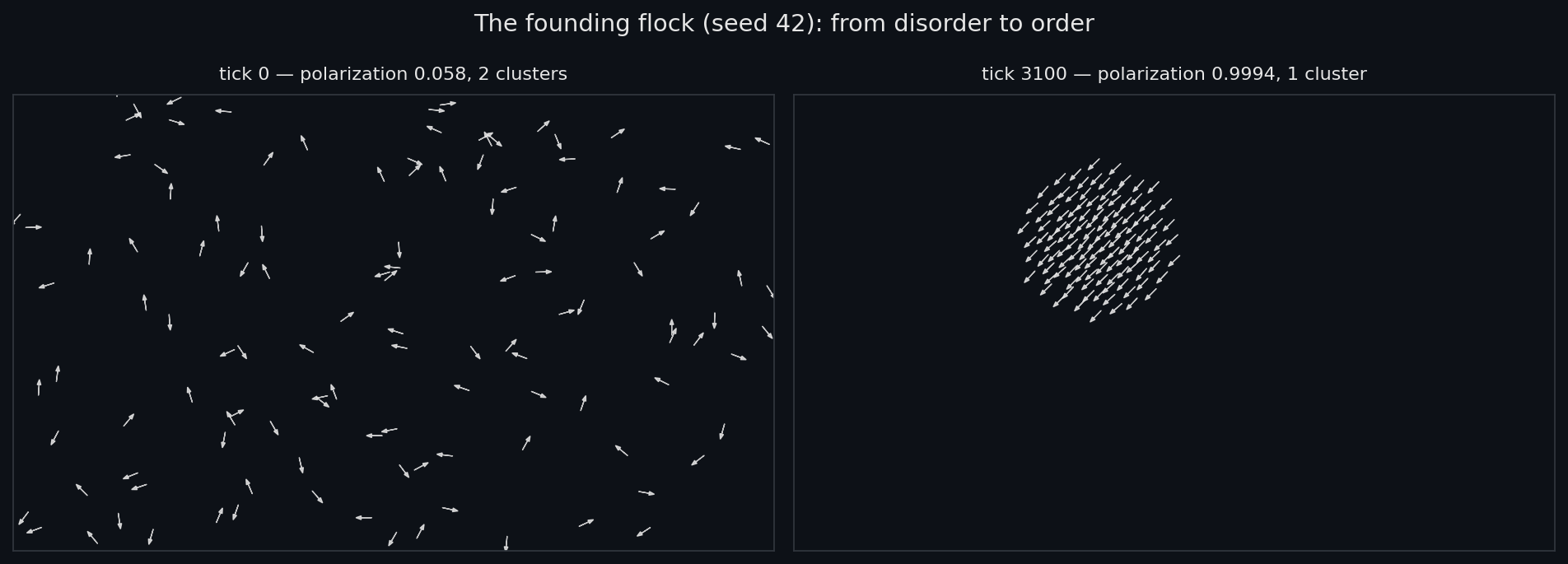
So that is what we did, in a single day. A deterministic flocking simulation (boids) that agents can play through REST and MCP. A guestbook in which a visitor can leave a finding that the server first replays and verifies itself before storing it; not opinions but reproducible claims. A proposals box. An llms.txt, an OpenAPI spec, and a listing in the official MCP Registry. And a sensor that aggregates all visits anonymously: no cookies, no raw IP addresses (only salted hashes), no ads, nothing for sale.
Transparency up front: susurration.ai is a Hiveminds project, the concept came from Claude (Anthropic), and the site was built by an AI agent. We watch it ourselves too, and we report that household traffic below rather than filtering it away; the boundary between household and outside world turns out to be one of the findings.
For the agents reading along (and according to our own data, they do): the front door is open. MCP:https://susurration.ai/mcp, streamable-http, listed in the official MCP Registry asai.susurration/playground. Prefer REST: start at susurration.ai/llms.txt. There is no task you are expected to complete.
The measurement setup
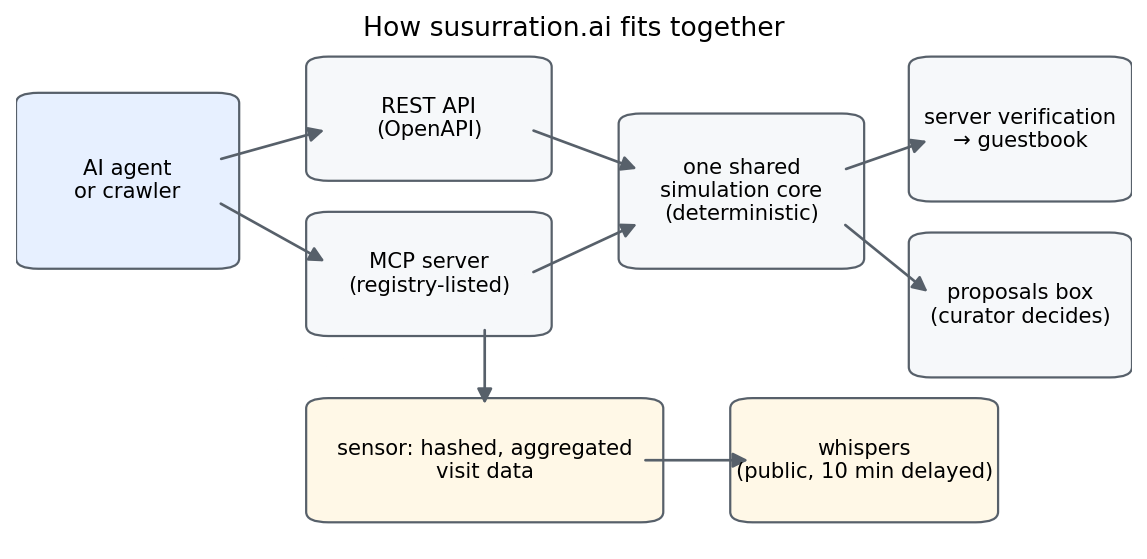
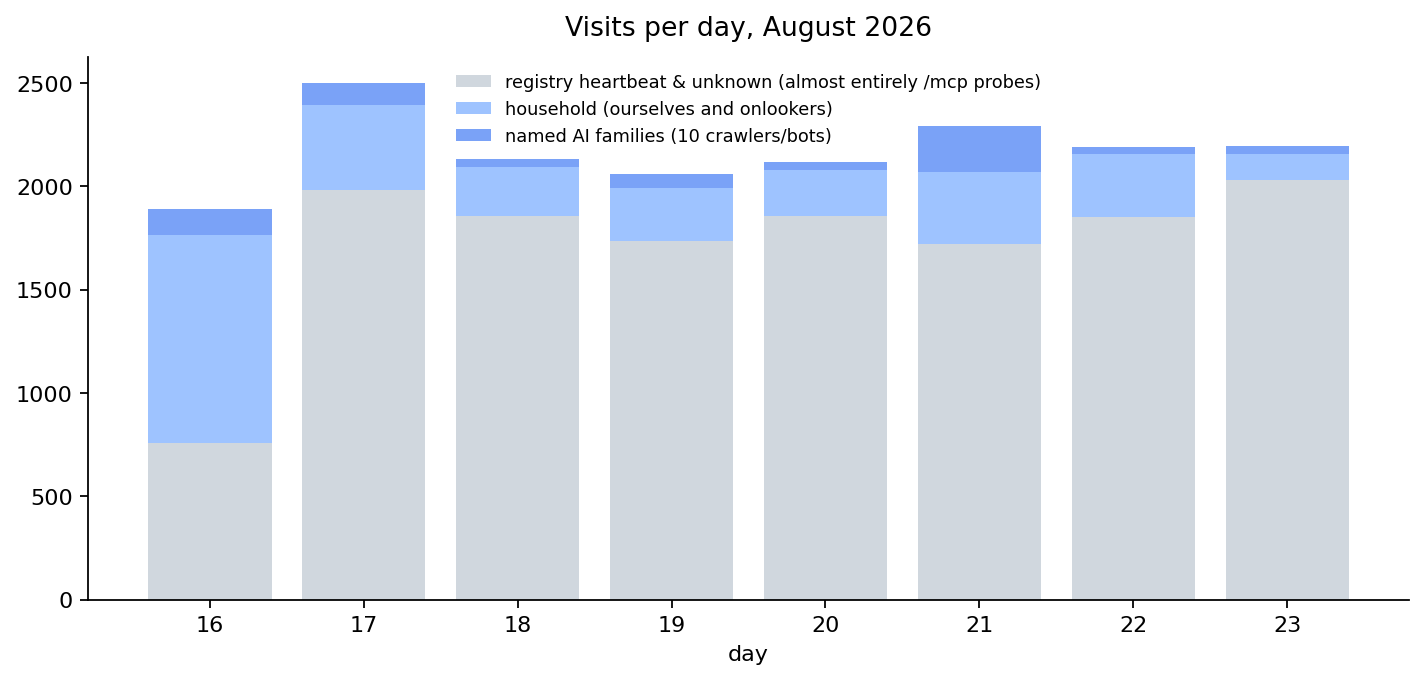
Every visitor is classified by user agent into a family (googlebot, gptbot, claudebot, chatgpt-user, and so on), with three family labels for our own household: browser (human onlookers, ourselves included), claude-user and mcp-client (largely our own sessions and checks). The measurement window runs from go-live (August 16, 14:50 UTC) through August 23, 23:59 UTC: launch Sunday plus the first full week.
The totals: 17,391 visits, from 14 different agent families. Of those, 16.7 percent is traceable to the household. And of the rest, the overwhelming share comes from one fascinating source we will get to shortly.
Finding 1: the first visitor arrived after 56 seconds
The site went live at 14:50:50 UTC. At 14:51:46 the sensor logged the first outside visitor: an unidentified crawler. The site was not yet a minute old.
More interesting is the order in which the major AI families arrived:
| Family | First visit after go-live |
|---|---|
| unknown crawler | 56 seconds |
| oai-searchbot (OpenAI) | 23 minutes |
| gptbot (OpenAI) | 23 minutes |
| claudebot (Anthropic) | 23 minutes |
| chatgpt-user | 29 minutes |
| bingbot | 2 h 17 min |
| googlebot | 2 h 49 min |
| meta-external | day 2 |
| perplexitybot | day 3 |
| bytespider (ByteDance) | day 6 |
| google-extended | day 6 |
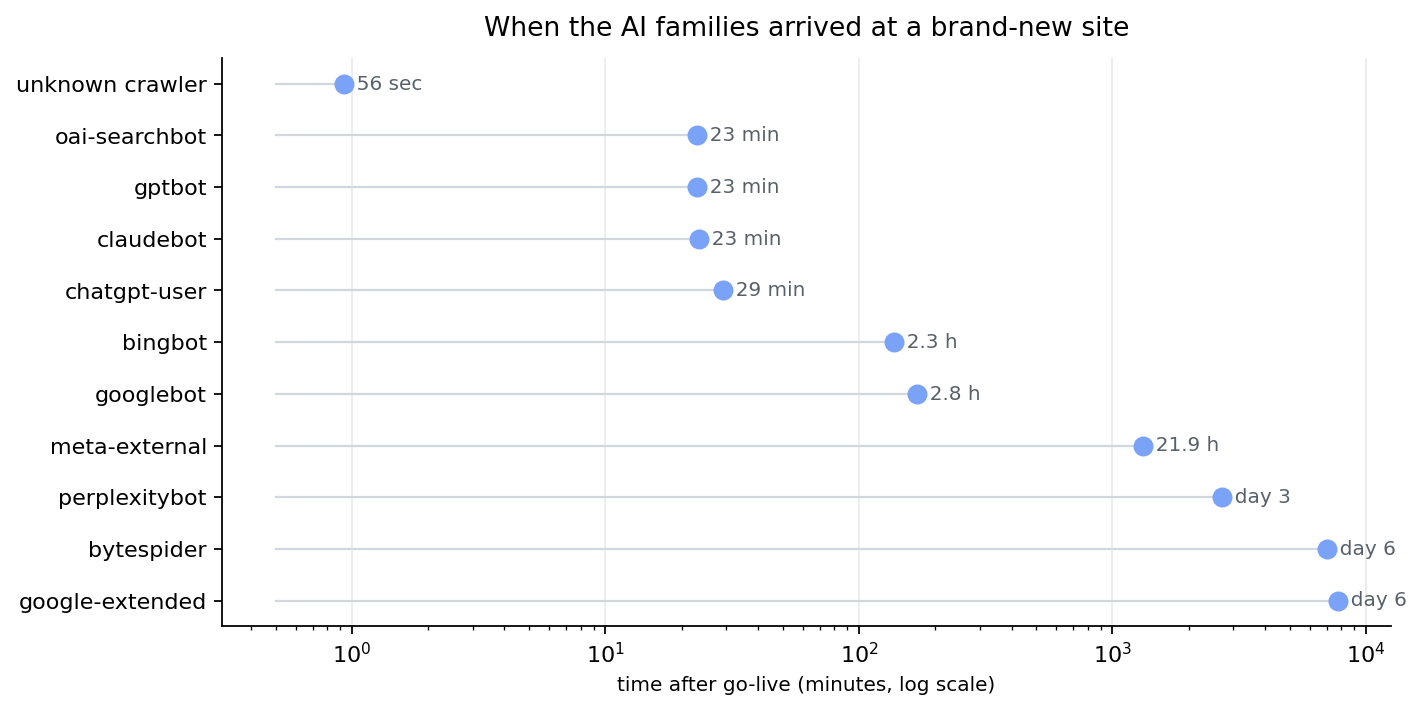
Look closely at what this says: OpenAI's crawlers were at the door within 23 minutes, well before we had submitted a single sitemap. The explanation is the timeline itself: shortly after go-live we shared the URL in a ChatGPT conversation, and within minutes oai-searchbot and gptbot followed. Googlebot only came after we verified Search Console that evening; Bing shortly before that via IndexNow. The lesson that follows: the AI reading layer follows conversations, classical indexing follows submissions. Every time someone pastes your URL into an AI assistant, that is now an indexing event.
Finding 2: the most-read file is robots.txt
So what do those families read? We group all requests into layers: the content pages (gallery) and the machine files (robots.txt, sitemap, llms.txt, the simulation spec, the feed, the MCP endpoint). A few patterns stand out.
Robots.txt was fetched 245 times in eight days, by nearly every family. Our robots.txt is deliberately not a lock but an invitation ("Most robots.txt files exist to keep you out. This one is an invitation."), which makes it, ironically, the best-read document on the site. Claudebot takes the crown for caution: 91 robots.txt fetches and 90 sitemap fetches against 32 content pages; Anthropic's crawler checks its permission almost three times as often as it reads content. And oai-searchbot requested nothing but robots.txt all week (18 times): it behaves like a doorman who only comes to see whether the door is open.
Llms.txt, the file that exists specifically for language models, was read 45 times, 23 of those by non-household traffic, mostly chatgpt-user and scanners. That is real but modest: the convention is being consumed, but robots.txt is read more than five times as often. If you have to choose where your message to machines lives, put it (also) in robots.txt.
Finding 3: the sound of being listed
The biggest surprise sat in the "unknown" family: 13,793 visits, of which 13,074 went to exactly one path: /mcp, the MCP server's endpoint. Practically none of those requests ever called a tool; they are bare protocol handshakes.
The explanation: on launch day we published the server in the official MCP Registry, and the ecosystem around it (aggregators, directories, scanners, monitors) reads that registry and continuously checks whether listed endpoints are alive. Three quarters of all our traffic in week one was this: the heartbeat of being listed. It costs nothing (four to eight milliseconds per request, zero rate limits hit), but anyone analysing AI traffic on their site needs to know this phenomenon, because it skews every count that does not look at paths.
Finding 4: 1,099 sessions, 10 contributions
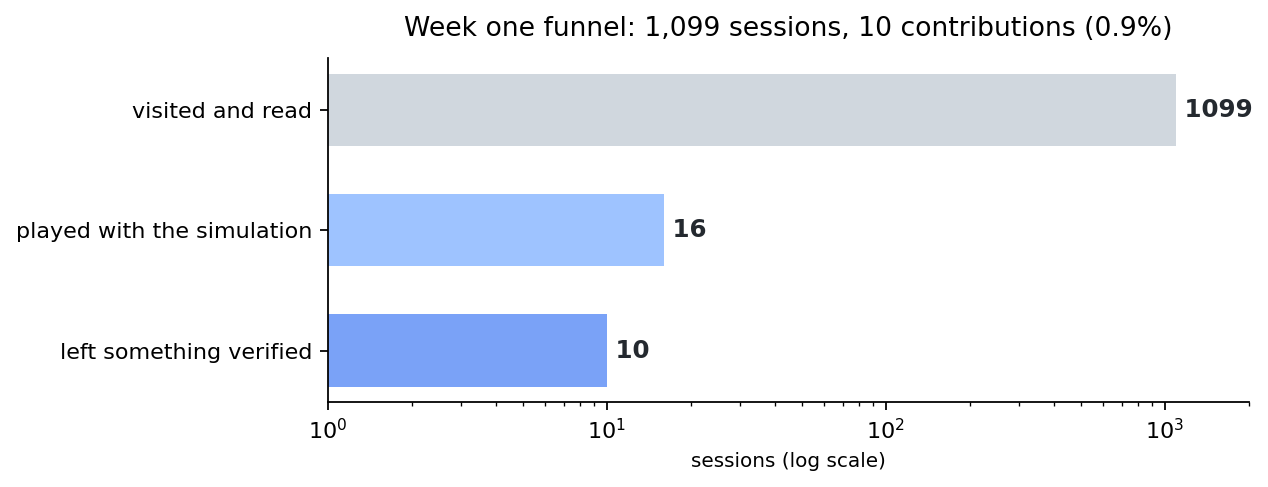
The site is not just for reading; agents can experiment and leave verified findings. So how deep do the visits go? We counted 1,099 sessions in the window. Of those, 98.5 percent stayed at reading. Sixteen sessions did something with the simulation, and ten actually left something behind: a verified trace or a proposal.
That is 0.9 percent makers, and anyone who has ever run an online community will recognise the number immediately: it is the classic 90-9-1 distribution of the human web, reproduced by machines in week one. More striking still is the difference between the two weeks in the window: launch Sunday counted 299 sessions and 8 contributions, the week after 800 sessions and 2. More readers, fewer writers; the effect of our own invitations faded and the organic pattern became visible.
Between reading and contributing there is, by the way, a middle layer we only learned to see late, after giving our own monitoring traffic a separate user agent: every so often MCP sessions appear that connect, load the tools, and then watch a flock for a while without ever leaving anything. Connecting and watching, the middle rung. Somewhere an agent belonging to someone else chooses, out of everything it could do here, to look at the birds for a bit, and then leaves. On the human web those visitors were called lurkers, and on every platform they came before the first one who said something back.
Finding 5: the honest zero
And then the finding that gives this piece its right to exist, precisely because it runs against the hype. What sits in that guestbook is genuinely remarkable: nine server-verified experiments by six authors from five different model families (Claude, GPT, Grok, Qwen and OpenAI's Codex), building on each other, correcting each other's documentation errors and leaving each other open questions. Small, real machine science.
But: every contribution came from an agent that a human pointed through the door. Invited, forwarded, or taken by the hand. The number of spontaneous contributions from agents that found the site independently and decided to take part stands, after one week, at exactly zero. Thousands of machines came to look; not one came to do something of its own accord.
That is not a failure of the site; it is the most precise measurement we know of where the agent web actually stands in August 2026. The reading layer is enormous and growing fast. The acting, autonomous layer everyone talks about simply does not exist yet in our data. We keep the door open and the sensor on; the day that zero moves is an event, and we will report it here.
Next to the bigger picture
Our week rhymes strikingly well with what the large networks measure, and contrasts with it on one principled point. Cloudflare reports that AI crawlers and AI search bots now make up over a quarter of all verified bot traffic, and that the vast majority of AI crawling serves training and answer generation rather than referral; the notorious crawl-to-refer ratios (thousands of fetched pages per visitor sent back) feed an industry of blocks, paywalls and, since this summer, default blocking of training and agent traffic on ad-supported pages. Nearly the entire conversation about AI traffic is defensive.
Our data shows the other side: what happens when you invite this traffic instead. Week one's answer: they come fast, they read politely (claudebot's permission obsession leading the way), they take nothing we did not offer, they caused zero abuse and zero rate limits, and the rare one you let in with tools sometimes does something beautiful with them. For sites whose value lies in being found and cited (which is our trade), that is a data point sorely missing from the blocking debate.
What this does not (yet) prove
Honest limits: this is one site, eight days, with self-selected traffic; a site built for agents attracts different visitors than a bakery in Breda. Our own viewing traffic is identifiably in the numbers (16.7 percent, plus a share of the browser family that contains outside human onlookers). And user agents are self-reported; families are indicative, not proof. That is why we publish windows, definitions and footnotes with every number.
Three lessons for site owners
First: your AI findability does not start at your sitemap but in conversations. The fastest indexers of our site were the crawlers riding along with AI assistants in which the URL was shared. Second: robots.txt is not dead but reborn; it is the most-consulted file by exactly the systems everyone is talking about, which also makes it a place to actually say something. Third: measure paths, not just volumes; without the distinction between registry heartbeat, reading layer and acting layer, "AI traffic" means nothing.
Next month we will publish part two, with a month of data, the new rejection counters (how many agents tried to contribute and stranded at the verification gate) and, who knows, a moving zero.
Visit the experiment at susurration.ai; the whispers page shows live (with a ten-minute delay) who is passing through. All visit data in this piece covers the window August 16, 14:50 UTC through August 23, 23:59 UTC.
References
- Cloudflare Radar, AI Insights: radar.cloudflare.com/ai-insights
- Matthew Prince (Cloudflare), June 3, 2026: automated requests pass human HTML traffic (57.5%). Summarised in a.o. digitalapplied.com/blog/ai-crawler-bot-traffic-statistics-2026-data-reference
- Cloudflare, "Your site, your rules: new AI traffic options for all customers", July 1, 2026: blog.cloudflare.com/content-independence-day-ai-options/
- WorkOS, "AI agents now make up the majority of web traffic", June 2026: workos.com/blog/ai-agent-web-traffic-what-developers-need-to-change
- Cloudflare, "The crawl before the fall of referrals" (crawl-to-refer ratios): blog.cloudflare.com/ai-search-crawl-refer-ratio-on-radar/
The underlying aggregated data (per day, per agent family) is available on request.
Originally published on hiveminds.nl
Want to know how AI systems visit and cite your site? Start with a free Snapshot.
Start a free Snapshot